
Navratri 2026: Aarti Timings, Aarti Bhajans & Aaj Ka Panchang for Daily Puja
Navratri is a time of devotion, prayer, fasting, music and family traditions. For nine days, devotees worship different forms of Maa Durga and follow rituals according to their beliefs and household customs.
But during the festival, a few practical questions come up almost every day.
What is today’s tithi? When should we plan our prayer? Which Aarti can we listen to? What does the Panchang say about the day?
Instead of searching for each detail separately, features such as Aarti Timings, devotional Aarti Bhajans and Aaj Ka Panchang can make the daily Navratri routine easier to follow.
Whether you celebrate Navratri with a short morning prayer, a family Aarti in the evening or a longer devotional routine, having important information in one place can save time and help you stay focused on the festival.
Why Daily Planning Matters During Navratri
Navratri is different from a one-day festival.
The celebration continues for several days, and each day has its own importance. Families may follow different traditions, fasting routines and prayer schedules throughout the festival.
That makes daily planning useful.
A regular calendar can tell you the date, but it may not tell you the traditional details that people often look for during a Hindu festival.
This is where a Panchang becomes helpful.
You may want to know the current tithi before beginning your prayer. You may also want to check sunrise, nakshatra or other daily information.
At the same time, you may want quick access to an Aarti or Bhajan without searching through different platforms.
Bringing these needs together creates a much simpler experience.
What Is Aaj Ka Panchang?
Aaj Ka Panchang is a daily Hindu calendar reference that provides traditional information about the day.
It is commonly checked during festivals, fasts, pujas and other religious occasions.
For someone who is new to Panchang, some of the terms may look complicated at first. But you do not need to understand the full calculation behind each element.
The most important thing is knowing what each detail represents.
Panchang Detail | Simple Meaning | How It Can Help |
|---|---|---|
Tithi | Lunar day | Helps identify the traditional day |
Nakshatra | Lunar constellation | Gives additional daily calendar context |
Yoga | Traditional Panchang calculation | Part of daily Panchang information |
Karana | Half of a tithi | Used in traditional calendar calculations |
Sunrise | Local sunrise time | Important reference for many daily observances |
Moonrise | Local moonrise time | Helpful for certain religious practices |
Muhurat | Traditionally suitable period | Can be checked when planning specific rituals |
For most users, checking the day’s important details is enough.
You do not need to turn your morning prayer into a complicated astrology lesson.
A simple glance at the daily Panchang can help you understand the traditional calendar context before you begin your Navratri routine.
Why Panchang Becomes More Useful During Navratri
During an ordinary week, many people may not check the Panchang every day.
Navratri is different because each day is part of a larger religious observance.
Someone following the festival may want to know which day of Navratri is being observed, what the current tithi is and whether there are any important daily details to keep in mind.
This becomes especially helpful for people who are learning about Navratri traditions for the first time.
Younger family members may know how to perform Aarti but may not know what a tithi means.
Someone living away from home may want to continue the same routine they followed with their family but may not have access to a printed Panchang.
A mobile Panchang can make this traditional information much easier to access.
Aarti Timings and Daily Navratri Worship
Aarti is one of the most familiar parts of Navratri worship.
For many families, it is the moment when everyone comes together.
Some people prefer morning Aarti before starting work or college. Others gather in the evening when the entire family is at home.
There is no single schedule that every household follows.
Family traditions, regional practices and personal routines can all be different.
That is why Navratri Aarti Timings can be useful as a convenient reference.
Instead of searching repeatedly for prayer-related information, users can check what they need and continue with their routine.
The purpose is not to replace a family tradition.
It is simply to make relevant information easier to find.
Why Aarti Is Such an Important Part of Navratri
Aarti is more than a song.
For many devotees, it is an important part of the prayer experience.
The diya, devotional words and family participation together create a moment that feels very different from simply listening to music.
During Navratri, this feeling can become even stronger because the ritual is repeated across several days.
For some families, Aarti happens after the main puja.
For others, it may be a shorter daily ritual before leaving for work or before dinner.
What matters most is the meaning attached to the practice.
Having easy access to Aarti content can help people participate even if they do not remember every word.
Aarti Bhajans: Devotional Music for the Festival
Navratri and devotional music naturally go together.
Bhajans can be played during prayer, family gatherings or quiet moments of devotion.
Some people enjoy traditional Maa Durga Bhajans, while others prefer familiar Aartis they have heard since childhood.
The role of devotional music is not limited to filling silence.
It can help create the atmosphere of the festival.
It can also make prayer more inclusive.
Children may not know the complete lyrics but can still listen and participate.
Someone who has moved away from their hometown may hear a familiar Bhajan and immediately feel connected to family memories.
Access to Aarti Bhajans can therefore be useful for both regular devotees and people who are rediscovering festival traditions.
Aarti and Bhajan Are Not the Same
People often use the two words together, but they usually serve different purposes.
Aarti | Bhajan |
|---|---|
Closely connected with a worship ritual | A devotional song or prayer |
Often performed with a diya | Does not require a ritual setup |
Common during or at the end of puja | Can be sung at different times |
Usually has a familiar ritual structure | Can have many musical styles |
Often shorter | Can continue for longer periods |
Both can be part of the same Navratri celebration.
A family may perform Aarti first and then spend additional time listening to Bhajans.
There is no need to choose between them.
They simply add different devotional experiences to the festival.
A Simple Navratri Puja Routine
One reason festival routines sometimes feel difficult is that people try to do too many things at once.
A simple structure is easier to maintain across all nine days.
Step | Daily Navratri Routine |
|---|---|
1 | Check the current Panchang details |
2 | Understand the day and tithi |
3 | Check the prayer or Aarti timing if needed |
4 | Prepare your puja space |
5 | Light a diya according to your tradition |
6 | Offer flowers or prasad if part of your practice |
7 | Perform or listen to Aarti |
8 | Spend a few minutes with a devotional Bhajan or prayer |
This routine is only an example.
Your own family may follow a different sequence.
The goal is to keep the process manageable instead of turning every Navratri morning into a long search for information.
Morning or Evening: When Should You Perform Aarti?
This depends largely on your household tradition.
Many people prefer morning prayer because it creates a peaceful start to the day.
Others find evening more practical because everyone can participate together.
A working professional may only have a few minutes in the morning but more time after returning home.
A family with children may prefer evening Aarti when everyone is available.
The most useful approach is to build a routine that you can follow consistently.
If your family has always followed a particular tradition, there is no reason to change it simply because another routine appears online.
Digital tools should help you organise your practice, not make it more confusing.
What Beginners Should Check First
If you are new to Panchang and Navratri rituals, start with the basics rather than trying to understand every traditional term at once.
Start With | Why |
|---|---|
Navratri Day | Helps you understand where you are in the festival |
Tithi | Gives the traditional lunar-day reference |
Sunrise | Useful daily Panchang information |
Aarti Timing | Helps organise prayer |
Aarti/Bhajan | Makes devotional participation easier |
Once these basics feel familiar, you can explore additional Panchang information such as nakshatra, yoga and karana.
This gradual approach is much easier than trying to learn everything in one day.
Using Panchang Without Making Puja Complicated
It is easy to see words such as tithi, nakshatra and yoga and assume that daily Panchang use must be difficult.
It does not have to be.
Think of it like checking the weather before leaving home.
You do not need to understand how every weather model works.
You simply check the information you need.
The same idea can apply to Panchang.
Open it.
Check the day.
Read the relevant information.
Then move on to your prayer.
The technology should save time rather than create another task.
Navratri for Busy Professionals
Festival routines can become difficult when they have to fit around office hours, commuting and family responsibilities.
That does not mean a person needs to skip their devotional routine completely.
A short morning prayer can still feel meaningful.
Someone may check the Panchang before breakfast, perform a brief Aarti and leave for work.
In the evening, they may spend a little more time listening to Bhajans or joining the family prayer.
Digital access can be especially useful here because the information is available whenever the person has time to check it.
The festival becomes easier to fit into everyday life without making the routine feel rushed.
Navratri for Students Living Away From Home
For students staying in another city, festival time can feel very different.
They may not have access to the same puja setup or family routine they grew up with.
But even a simple devotional routine can help maintain that connection.
Checking the day’s Panchang, lighting a diya where appropriate, listening to an Aarti and calling family afterwards can make the festival feel more familiar.
Aarti and Bhajan access can be particularly meaningful because devotional music is often strongly connected with memories.
A familiar prayer can bring a sense of home even when someone is far away.
Helping Children Understand Navratri
Navratri is also an opportunity to introduce younger family members to traditions.
Instead of asking children to memorise everything immediately, parents can keep the explanation simple.
For example, while checking Aaj Ka Panchang, they can explain that tithi is part of the traditional Hindu calendar.
During Aarti, children can listen and gradually learn the words.
Bhajans can make this process even easier because music is often easier to remember than explanations.
The focus should be on participation and curiosity rather than making the festival feel like a lesson.
Over time, these simple family routines can become lasting memories.
Panchang and a Regular Calendar Serve Different Purposes
A normal calendar and a Panchang are both useful, but they answer different questions.
Regular Calendar | Aaj Ka Panchang |
|---|---|
Shows date and weekday | Shows traditional Hindu calendar details |
Useful for everyday scheduling | Useful for puja and festival context |
Easy to use for appointments | Includes tithi, nakshatra and other information |
Focuses on Gregorian dates | Includes lunar-calendar details |
Used for general planning | Often checked during religious observances |
A regular calendar may tell you which date Navratri begins.
Aaj Ka Panchang helps you understand the traditional details connected with a particular day.
This is why the two can be used together without replacing each other.
Why Location Can Matter for Panchang Timings
One important thing to remember is that some traditional timings can depend on location.
Sunrise is not exactly the same everywhere.
Because certain Panchang calculations use local time references, information displayed for one city may not always match another city exactly.
This is why people should be careful when using screenshots forwarded through social media.
A card may show a correct timing but for a different place.
Before following an exact time, check whether the information is relevant to your location.
This is particularly useful when planning rituals where a specific traditional time matters.
Common Navratri Information Mistakes
A few simple checks can make festival planning much easier.
Common Mistake | Better Approach |
|---|---|
Using an old festival screenshot | Check that the year is correct |
Following a timing without checking location | Use information relevant to your city |
Treating tithi exactly like a calendar date | Remember that lunar dates work differently |
Depending only on social-media forwards | Check current Panchang information |
Trying to follow every online ritual | Follow the tradition relevant to your family |
Navratri is celebrated in many different ways across India.
One family’s routine does not automatically have to become another family’s routine.
How Aarti Bhajans Can Bring Families Together
Some of the strongest festival memories are built around very simple moments.
A family standing together during Aarti.
Children holding flowers.
Parents preparing prasad.
Grandparents singing a Bhajan they have known for years.
These moments do not require a complicated setup.
Devotional music often helps everyone participate regardless of age.
Someone who does not know the complete prayer can still listen.
Someone who knows it well can sing along.
That shared participation is part of what makes festivals memorable.
Keeping Tradition Accessible in a Digital World
People now use phones for almost everything: work, travel, payments, communication and entertainment.
Using a phone to access traditional festival information does not automatically make the tradition less meaningful.
A printed Panchang and a digital Panchang can serve the same basic purpose: helping someone access information about the day.
Similarly, an Aarti played through a phone can still be part of a genuine family prayer.
The important question is not whether technology is involved.
It is how technology is being used.
If it reduces unnecessary searching and lets people focus more on prayer and family, it is serving a useful purpose.
How the App Can Support Your Navratri Routine
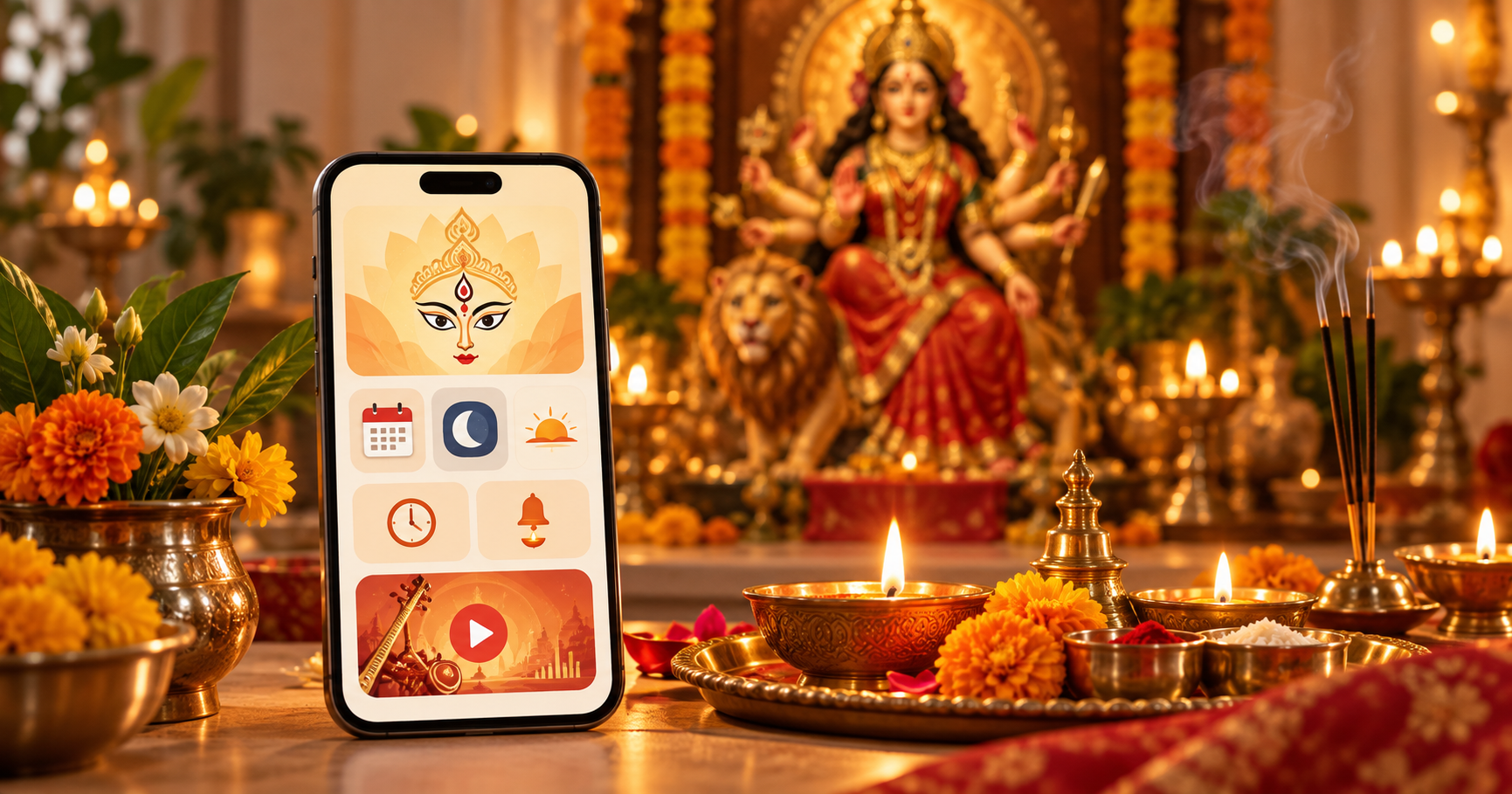
The app brings together features that can be useful before and during daily Navratri worship.
You can use Aarti Timings when planning your prayer, explore devotional Aarti content and check Aaj Ka Panchang for traditional daily details.
The value of having these features together is convenience.
You do not need one place for Panchang, another place for devotional audio and another search for prayer-related information.
Open the app, check what you need and return to your festival routine.
A Practical Navratri Checklist
Before Puja | During Puja | After Puja |
|---|---|---|
Check the day’s Panchang | Light diya according to your tradition | Spend time in quiet reflection |
Review tithi | Perform prayer | Listen to a Bhajan if you wish |
Check Aarti timing if needed | Perform or listen to Aarti | Continue with your day |
Prepare puja essentials | Offer flowers/prasad as followed at home | Keep the routine simple |
This type of structure can be especially useful for beginners.
It provides a clear starting point without suggesting that every family must perform exactly the same ritual.
Final Thoughts
Navratri is a festival that becomes meaningful through daily participation.
For one person, that may mean fasting.
For another, it may mean performing Aarti every evening.
Someone else may simply spend a few quiet minutes listening to a Bhajan before starting the day.
There is no need to make the experience unnecessarily complicated.
A daily Panchang can help you understand the traditional details of the day. Aarti Timings can make prayer planning easier, while devotional Aartis and Bhajans can help create a peaceful atmosphere at home.
Most importantly, these tools should support the tradition you already follow.
Use the information you need, keep the routine manageable and make space for the part of Navratri that matters most: devotion, family and reflection.
To access Aaj Ka Panchang, Aarti Timings and Aarti Bhajans, explore the app on Google Play.